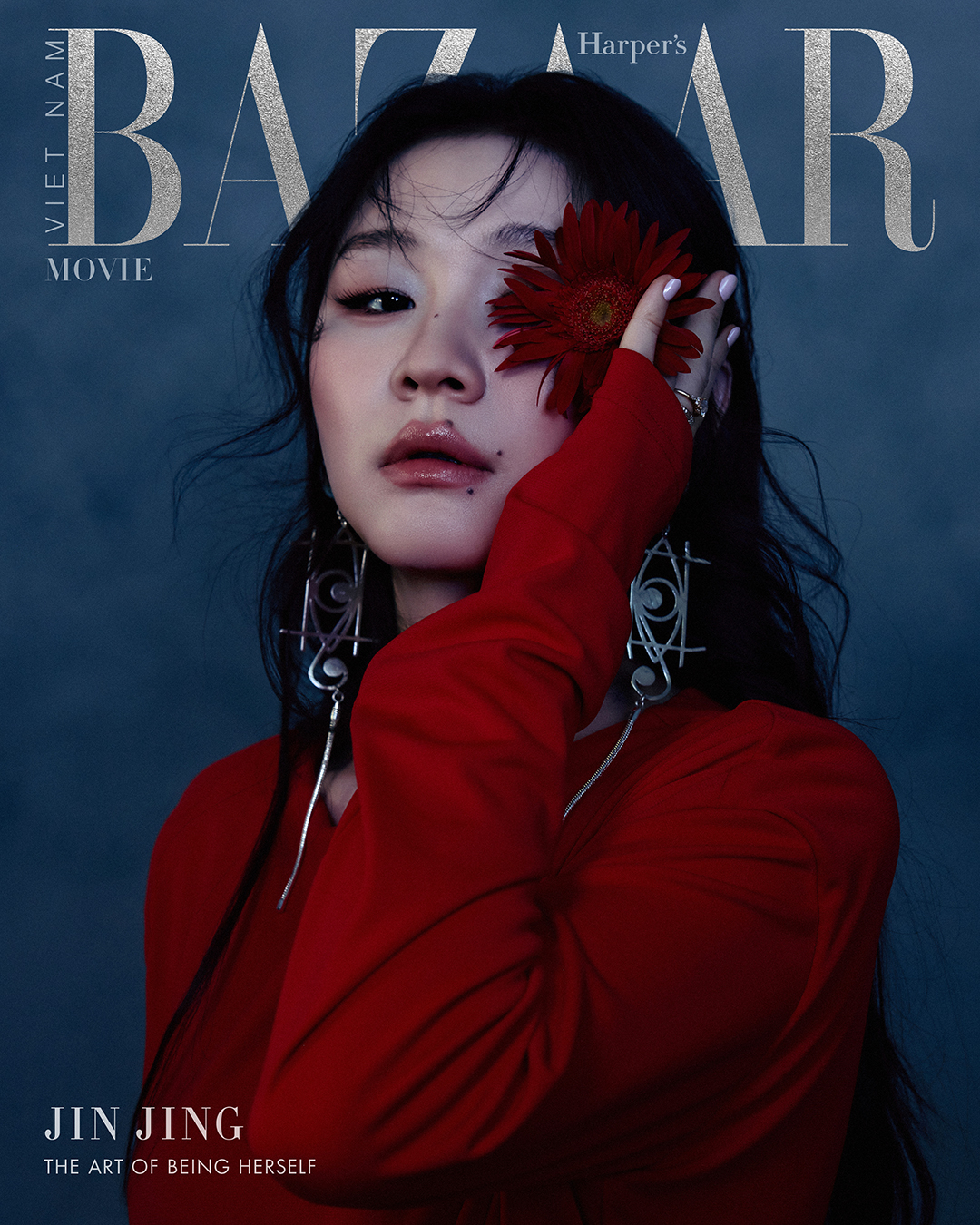
The backstage corridor is narrow, its lighting dim. Jin Jing sits before a dressing-room mirror, watching the person in the reflection become someone else.
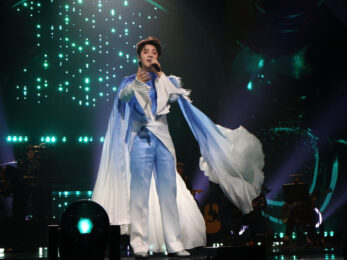
It is a moment before a performance of The Invisible Guest. Onstage, she must become both Lawyer Gu and Wei Jia – a calm, meticulous attorney and a gravely ill mother who assumes a lawyer’s identity to uncover the truth behind her son’s disappearance. More precisely, she must become “Lawyer Gu as portrayed by Wei Jia”: a performance within a performance, a play within a play.
“If it were simply a matter of distinguishing a younger person from an older one, it actually wouldn’t be that difficult. That’s a fairly ordinary acting technique,” she says. “What requires particular attention is that when you play Lawyer Gu, you have to convey the sense that she is already ill, perhaps even experiencing a final surge of vitality before death. Although she seems full of energy, there must still be a trace of illness about her.”
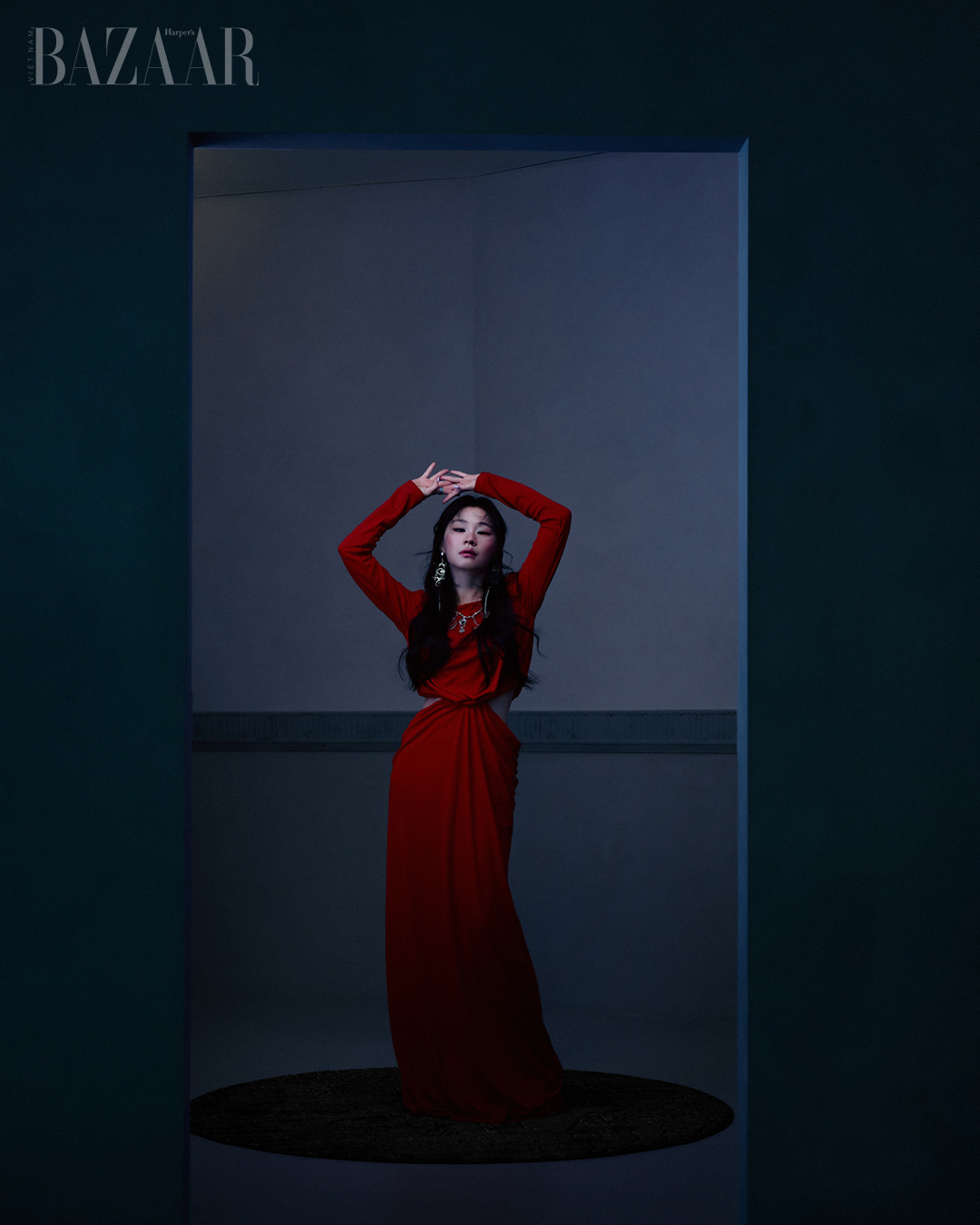
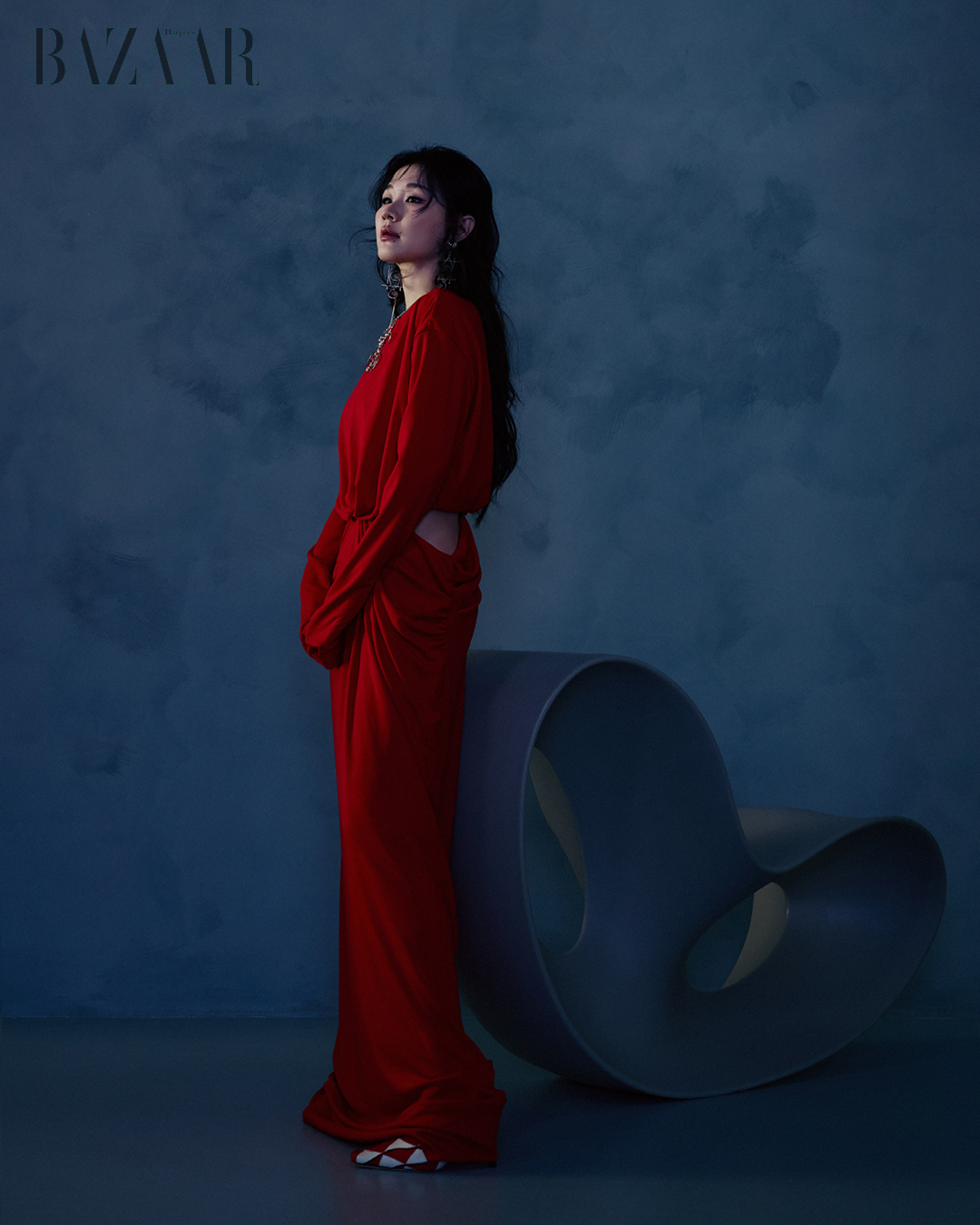
Dress: Shangyi by Shang1.
This is Jin Jing’s first time appearing in a stage play. The theater is different from performing for the camera. On camera, you can try again: if one take does not work, you shoot another. Onstage, there are no retakes. A performance must come together in one go; every night is new, yet every night must also be the same. But this does not make her anxious.
“I’m ALL RIGHT when it comes to ANXIETY. I don’t FEEL ANXIOUS very often.”
She says that once a performance for film or television has been recorded, it is fixed. What excites her more about theater is that “you have to keep performing the same play. The audience changes all the time, but I wonder whether someone might come to see it from the very first performance and, by now, notice that although you are doing the same thing each time, there are still differences. Every performance is different, yet you are performing the same material. Even after more than a dozen performances, each one has to feel like the first, while still being different from the others. There’s something quite wonderful about that.”
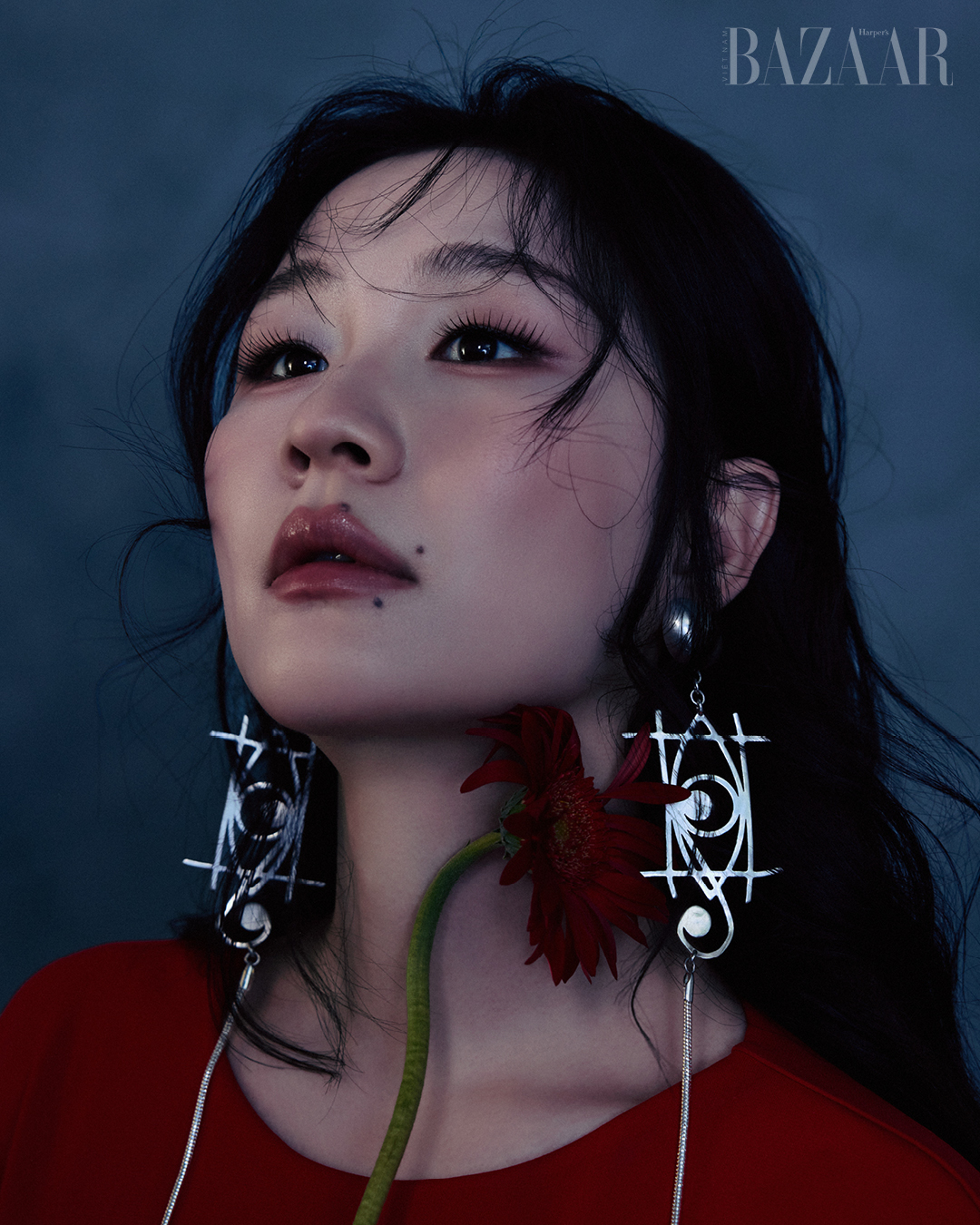
The Weight of the Stage
Zhang Jiayuan describes her as giving “absolutely everything, every single time” during rehearsals – so much so that she can fall asleep on the spot from exhaustion. Is this wholehearted commitment the same as the way she used to surrender herself completely on the improvisational stage?
Jin Jing thinks for a moment and says that perhaps, because she did not come from a formal acting background, she feels she must work especially hard every time. “I have a strong sense of pride. If I don’t perform well, I don’t want people saying they could already tell from rehearsals that she wasn’t any good. But if I keep putting in the effort and the outcome still falls short, people will say, ‘She already worked so hard in rehearsals. She did her best.’ That would make it easier for me to hear.”
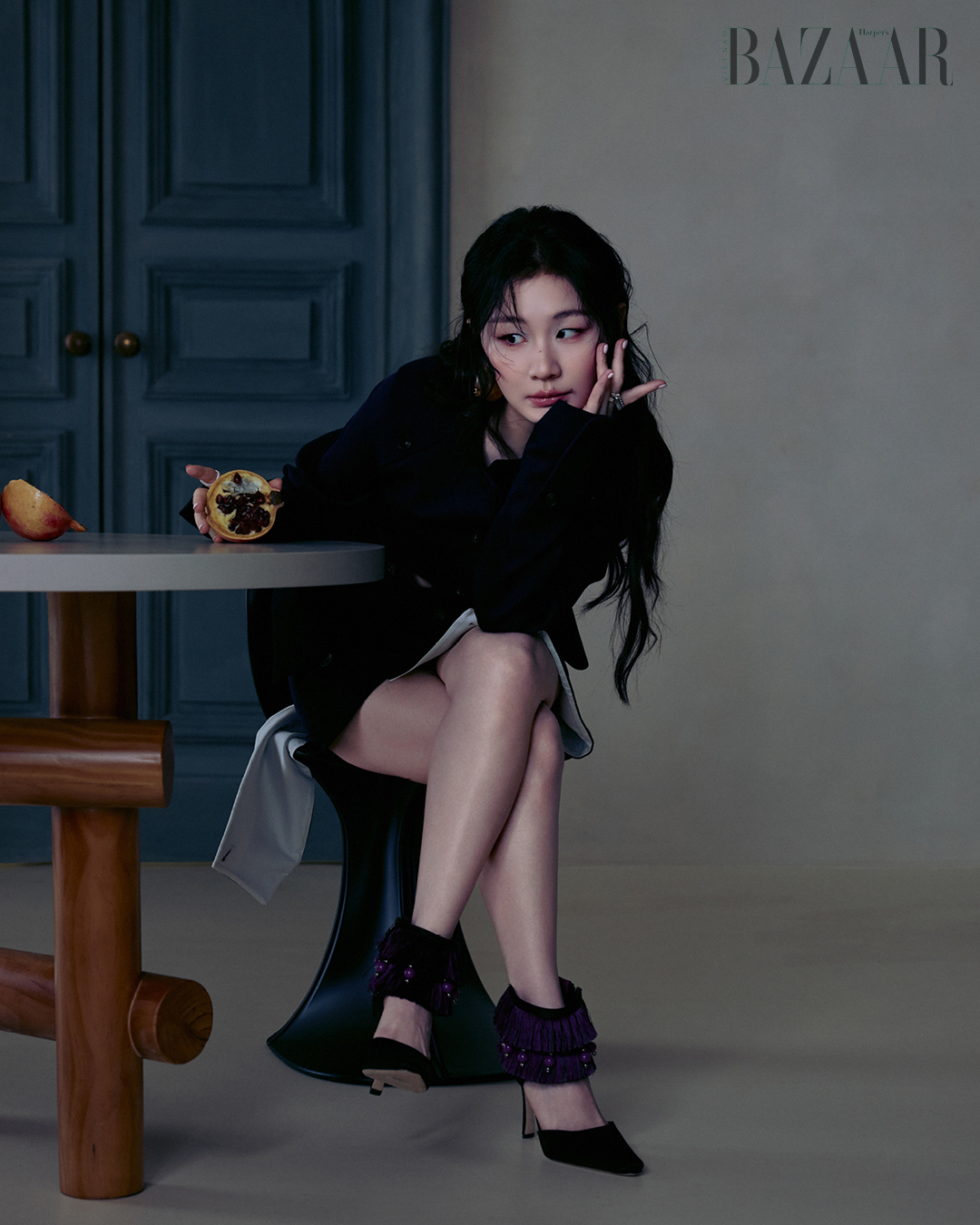
Dress, blazer and skirt: Ferragamo. Shoes: Manolo Blahnik. Earrings: Tokokkino. Ring: Olio e Aceto.
What improvisers are most accustomed to is failure. If the audience does not react, that is a failure. Experiencing this again and again has shaped her highly sensitive disposition, allowing her to gauge an audience’s response quickly onstage. In a stage play, however, audience reactions are delayed, and she cannot read them instantly as she can in improv. Asked whether this inability to judge makes her feel more relaxed or more uneasy, she shakes her head. She seems not to have given it much thought.
“When I’m PERFORMING, I don’t spend MUCH TIME thinking about the AUDIENCE’S JUDGEMENTS or feedback.”
She compares acting to making a product. “Some people who develop products care a great deal about what customers need, and they adjust the product accordingly. But others start from within themselves: I really want to make this product; I want it to serve a particular purpose; and then I hope to attract people who are very much like me. Acting is much the same. If you start with the audience and create a performance designed around what they like, they can sense it. If they feel you’re trying to please them or seeking their approval, they unconsciously become more critical. But if they see that you’re simply doing your own thing and expressing yourself, they’re more likely to regard you as an equal.”
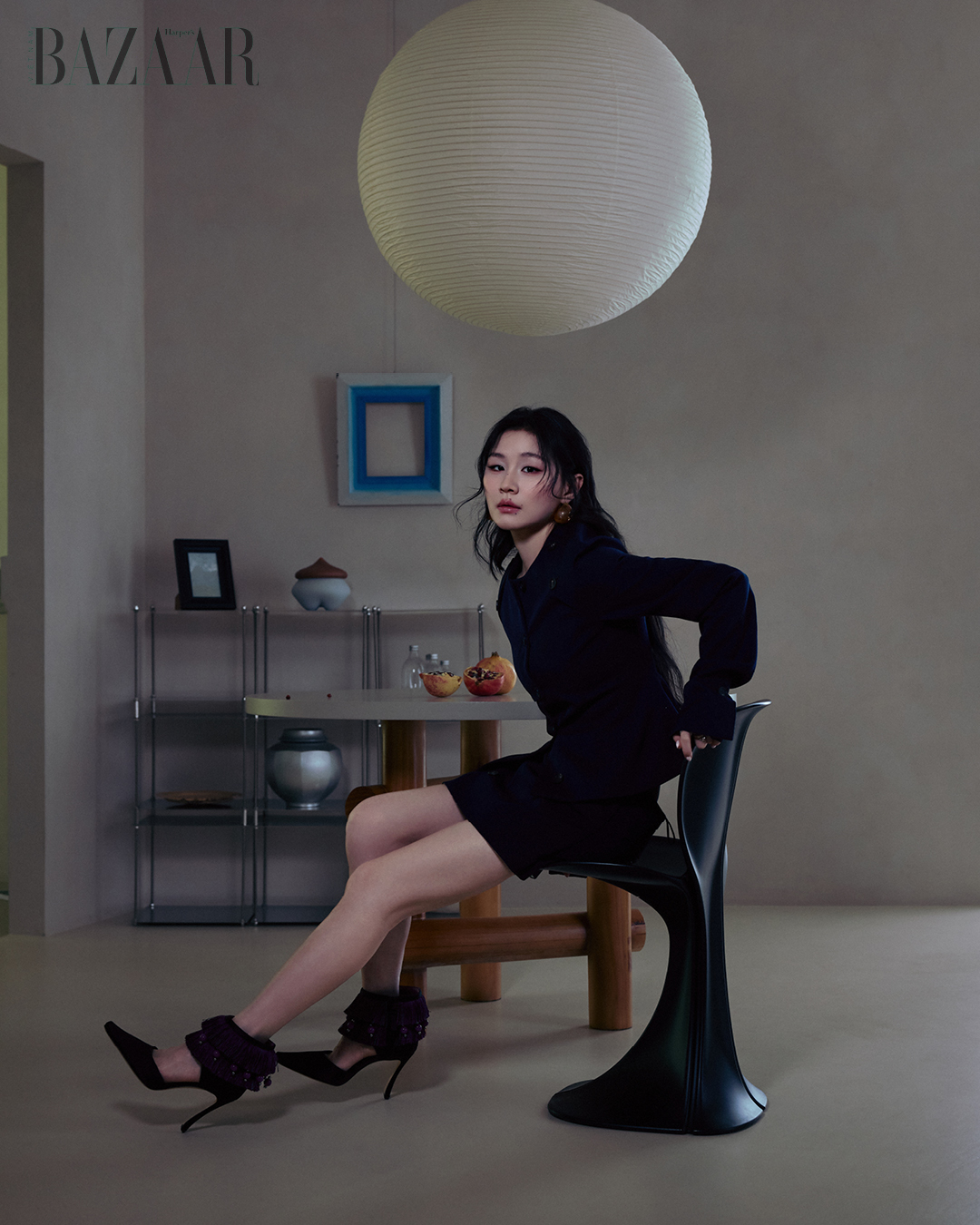
Dress, blazer and skirt: Ferragamo. Shoes: Manolo Blahnik. Earrings: Tokokkino. Ring: Olio e Aceto.
In working with director Ding Yiteng, Jin Jing encounters someone whom observers have likened to a microscope: a director adept at uncovering qualities hidden deep within actors and exacting to an extreme when it comes to detail. Asked whether the process has helped her rediscover her own qualities as an actor, Jin Jing does not rush to assign herself a label. She still sees herself as a newcomer in a period of growth. Nothing has fully taken shape yet, and there is still a great deal for her to learn and refine. It is too early, she feels, to define herself.
The most distinctive test of the stage has never been the great moments of emotional eruption, but the countless tiny choices nobody notices. During a performance, there are quiet moments without dialogue, when the audience may not be able to tell whether an actor is distracted or fully attentive. After a long stretch of work, when body and mind are exhausted, you can quietly conserve energy through technique and let your mind go blank – or you can stay true to the character and remain fully present. No onlooker may expose that lapse in effort, but the choice is one that only the actor can answer for.
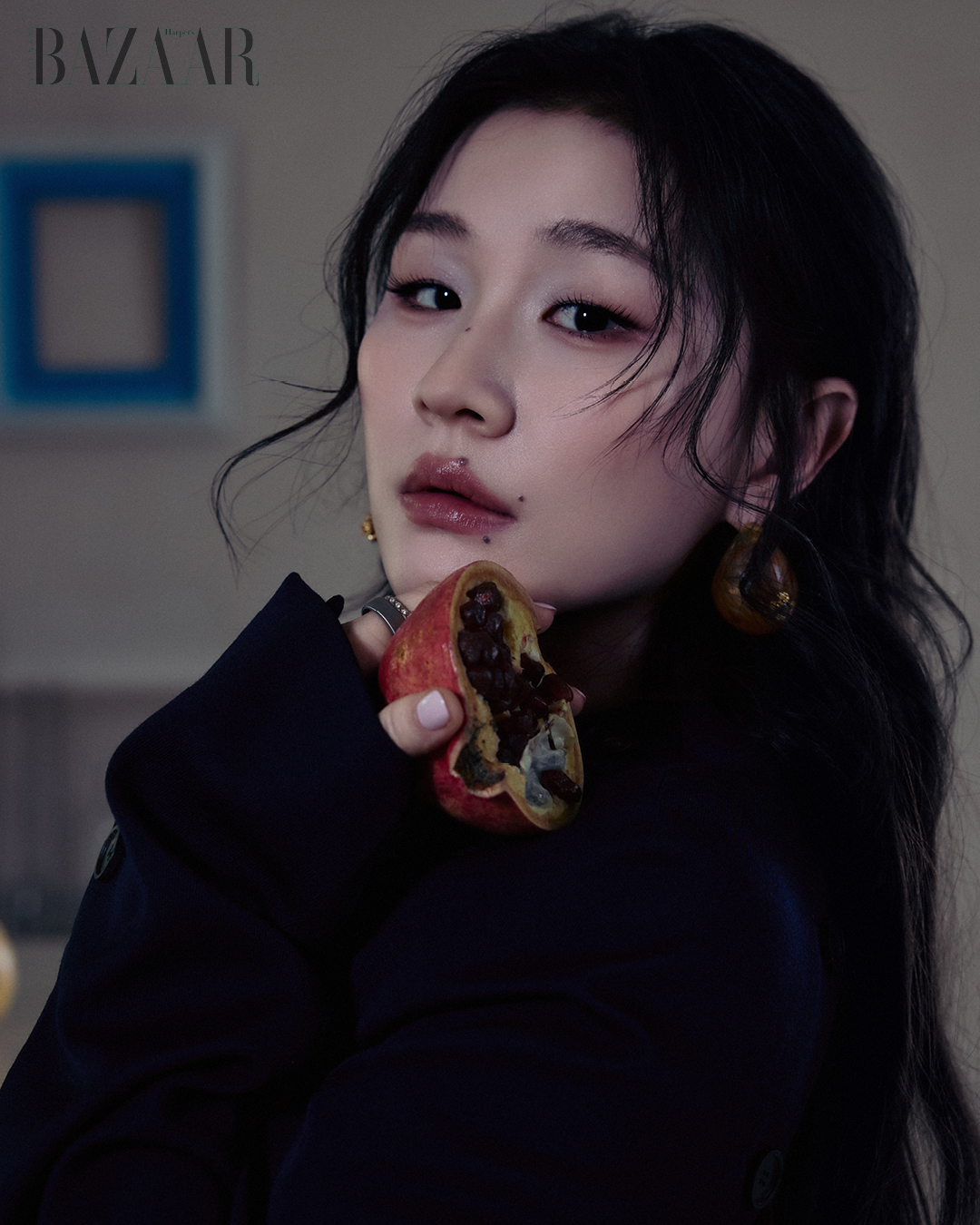
Dress, blazer and skirt: Ferragamo. Earrings: Tokokkino. Ring: Olio e Aceto.
The Layers of the Screen
In the film A part of me, Jin Jing plays Wang Meili. During the promotional roadshow, she once mentioned that the story touched on emotions she holds especially dear. Her brief remarks at the time left much to the imagination. When the subject comes up again, she smiles and explains that her remark was made in a particular context.
Feeling nervous before going onstage and worrying about giving a poor performance are normal. Yet when she formally steps into a role, Jin Jing’s own apprehensions temporarily recede, and she becomes Wang Meili.
The friendship between Wang Meili and Gao Fan cannot be measured by how long they have been together. It is a bond that transcends life and death and endures forever. Many wonder whether portraying such a profound relationship between women has changed her understanding of women’s emotional bonds. Jin Jing offers a gentle answer: it was not a startling new revelation, but a reaffirmation.
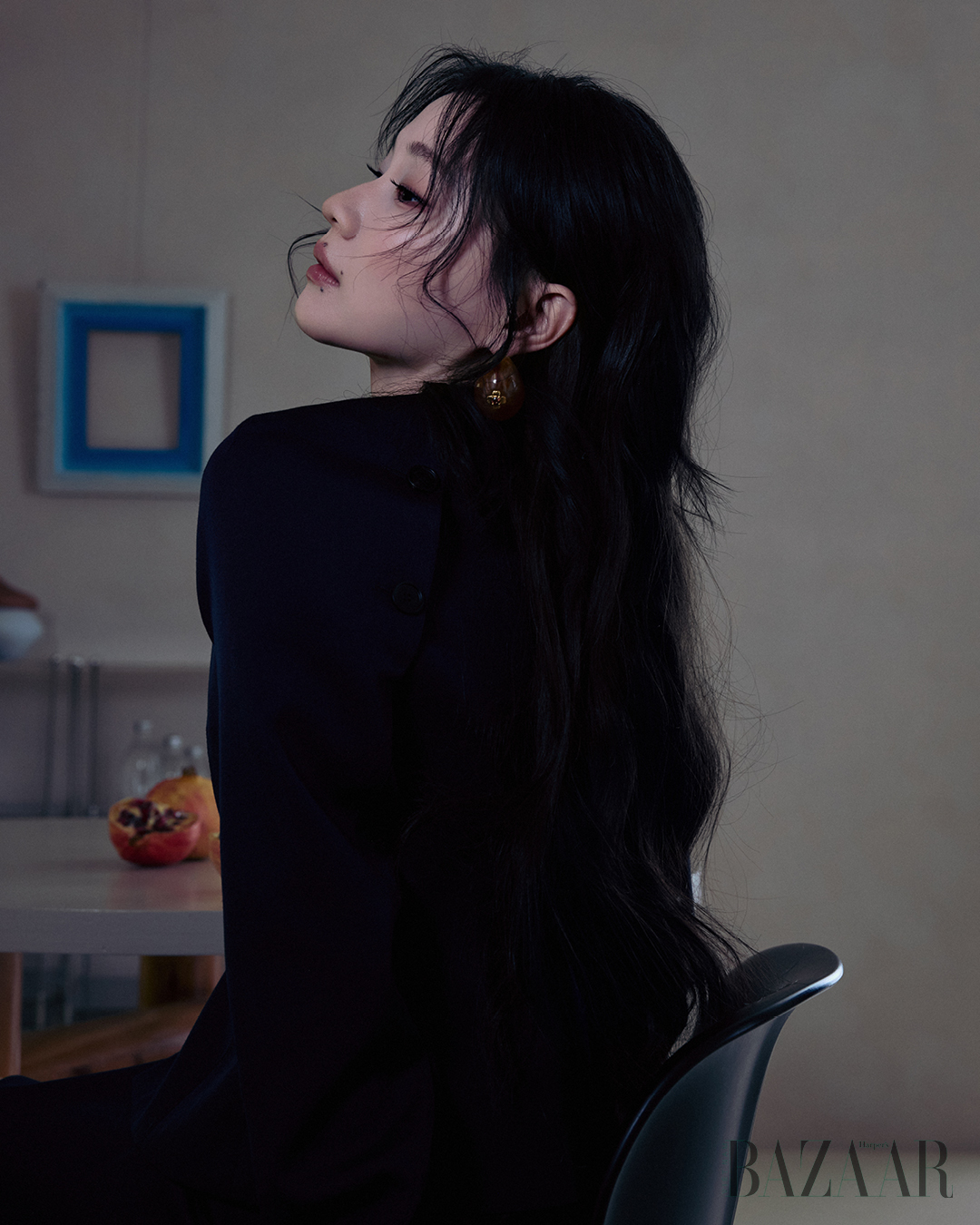
In the past, most of the sketch comedy she performed consisted of lighthearted vignettes of everyday life, with laughs taking priority. There was little room for expressing profound relationships between women. But friendship, attachment, and care are, in themselves, immense themes rooted deep in the human heart. They are not things you suddenly understand only because you have played a role. Just as we already know what home means, we do not need to act in a family story to learn all over again how to love our families.
Entering the story of Wang Meili and Gao Fan simply affirmed once more that good friendships between women grow gradually, with mutual trust and a strong reliance on one another. She had always understood this; the role merely gave that understanding a tangible form.
From Hu Jingjing in Remembrance of Things Past to Gong Zishang in My Journey to You, and then to Wang Meili, Jin Jing has portrayed characters across a wide range. Asked what is most likely to move her when choosing a script, she speaks clear-eyedly about the realities of the industry: personal preferences often have to come after practical considerations. Of course there are stories she longs to tell, but as an actor, she often has limited freedom to choose. When an opportunity comes along, she must weigh different factors; it is difficult to select a script based on personal taste alone.
This clear-eyed outlook has not left her feeling powerless.
“Everyone is WORKING under the SAME CONDITIONS, so there’s NO REASON to get caught up in NEGATIVE EMOTIONS over it.”
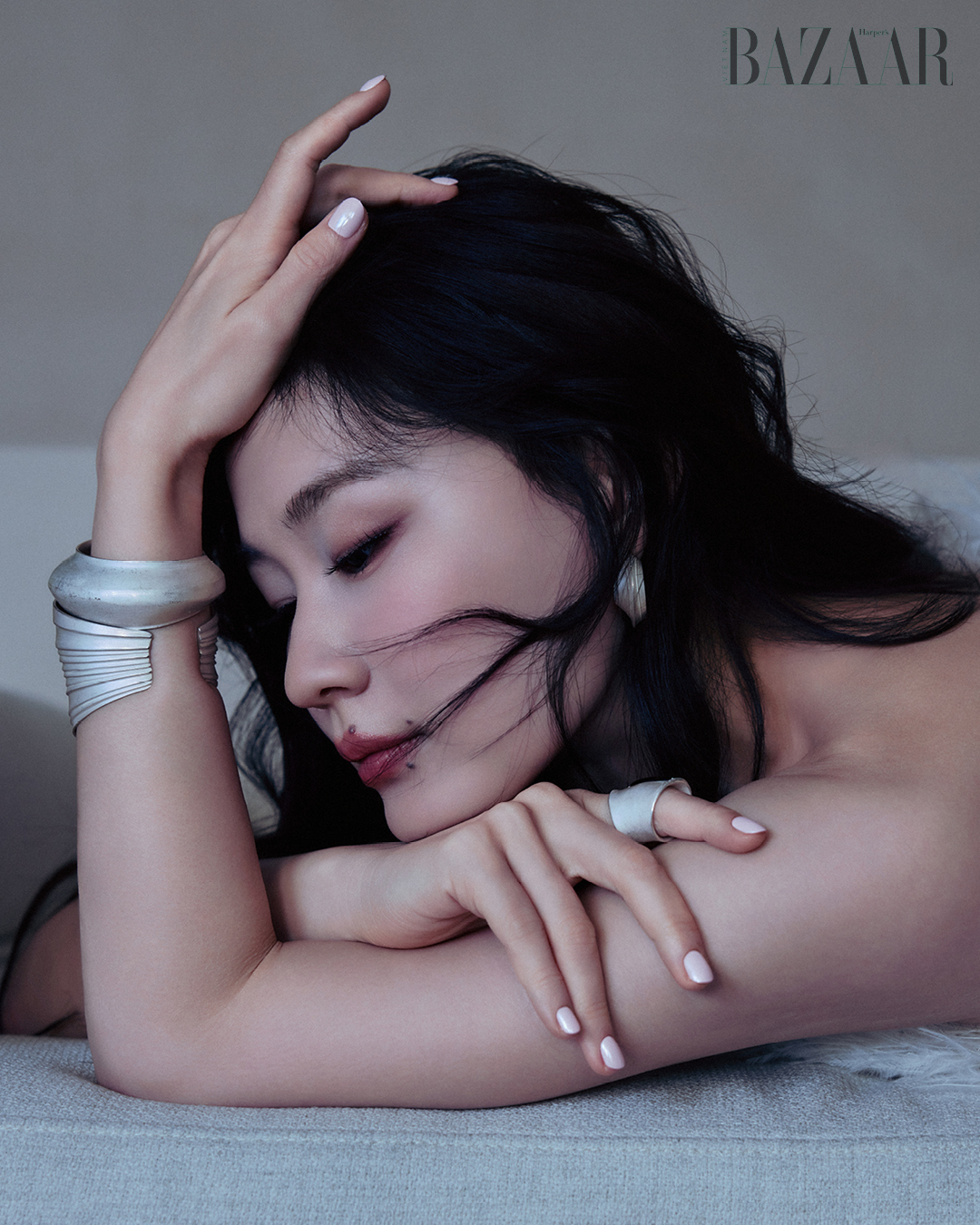
Dress: Awaylee. Bracelet and ring: Olio e Aceto.
The Measure Within
She once used a glass of water as a metaphor: generation after generation passes down fear, timidity, inner conflict, and darkness, like impurities suspended in water. She hopes to set aside and clear out some of those heavy emotions from her own glass. But she has no illusion that she can eliminate every negative feeling and reduce life to something entirely pure and white.
“There’s NO WAY for a person to POUR OUT both their A SIDE and their B SIDE. It’s not as though I can REMOVE all the BLACK and leave a WORLD that is only WHITE. I don’t think it’s THAT SIMPLE.”
The lesson she has gradually learned is how to live alongside these feelings. Struggle, inner turmoil, and vulnerability still resurface from time to time, and acceptance is the only way forward. There is no need to forcibly remove everything considered “bad”; human beings are made up of light and shadow together.
She has portrayed, one after another, a mother grieving the loss of her son and a woman confronting separation and illness. All these roles touch on the weighty subject of loss. Because she once had a habit of using jokes to ease pain, many wonder whether these characters have changed the way she processes sadness. Jin Jing says it is difficult to attribute changes in her own outlook directly to the roles she has played. In real life, she has not yet experienced a truly devastating personal loss; her feelings about parting and death remain within the realm of scripts and performances. A character does not forcibly rewrite her view of life, but it can quietly leave behind small, practical acts of kindness.
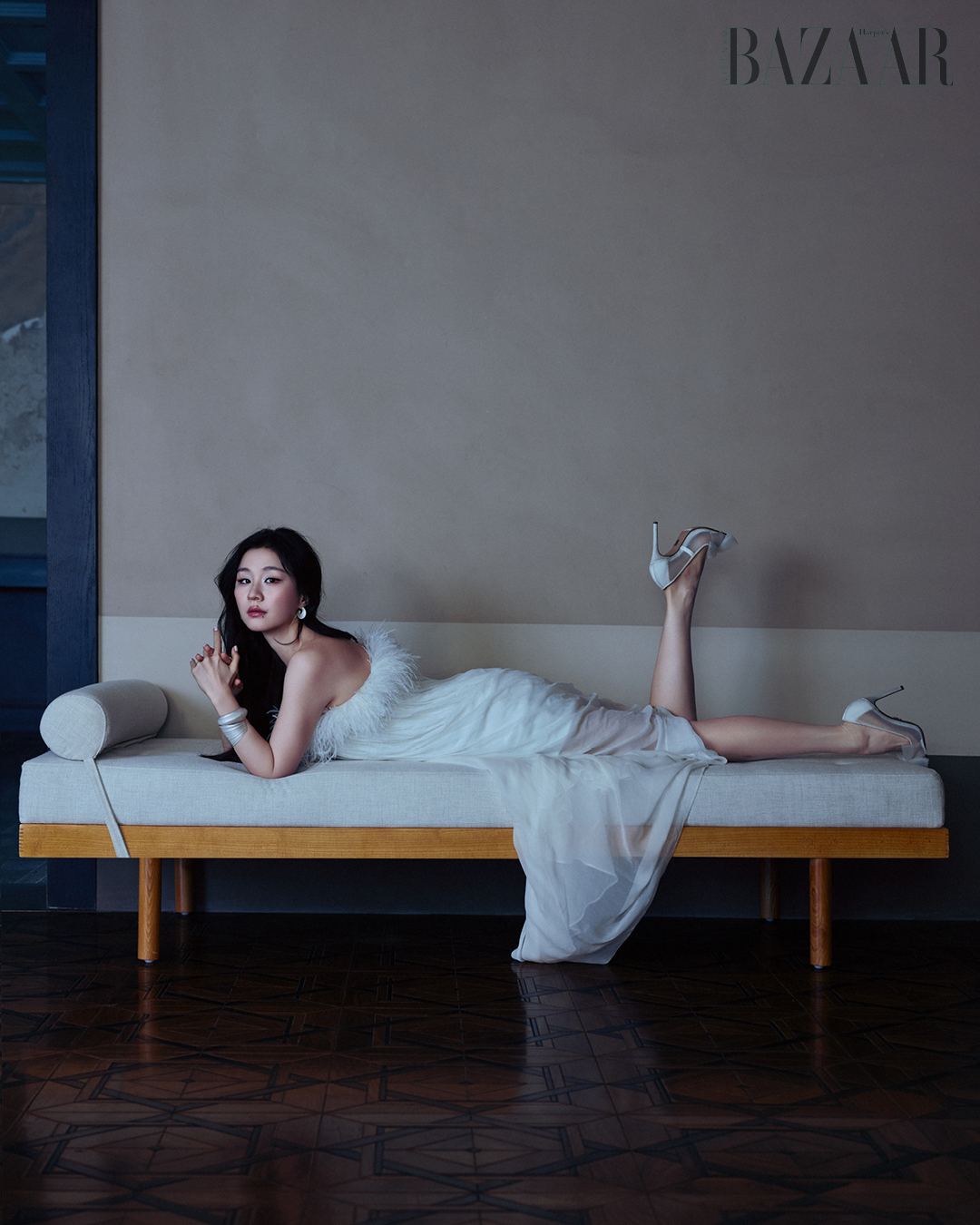
Dress: Awaylee. Shoes: Steve Madden. Bracelet and ring: Olio e Aceto.
A part of me taught her one small thing: the feelings people have for one another do not need to rest on grand, far-off promises. Rather than saying, “If something happens, I’ll look after your family,” she prefers the tenderness tucked into ordinary moments—offering someone a glass of water when they are thirsty, or casually throwing away their rubbish for them. Small, immediate acts of companionship within reach are, to her, the most dependable expression of affection.
Jin Jing rarely makes long-term plans for her life, knowing that reality often shatters them. Yet theater and film are precisely the kinds of creative work that unfold over long periods and offer delayed feedback. Prolonged effort does not necessarily bring an immediate response, and this rhythm has reshaped her understanding of the word “plan.”
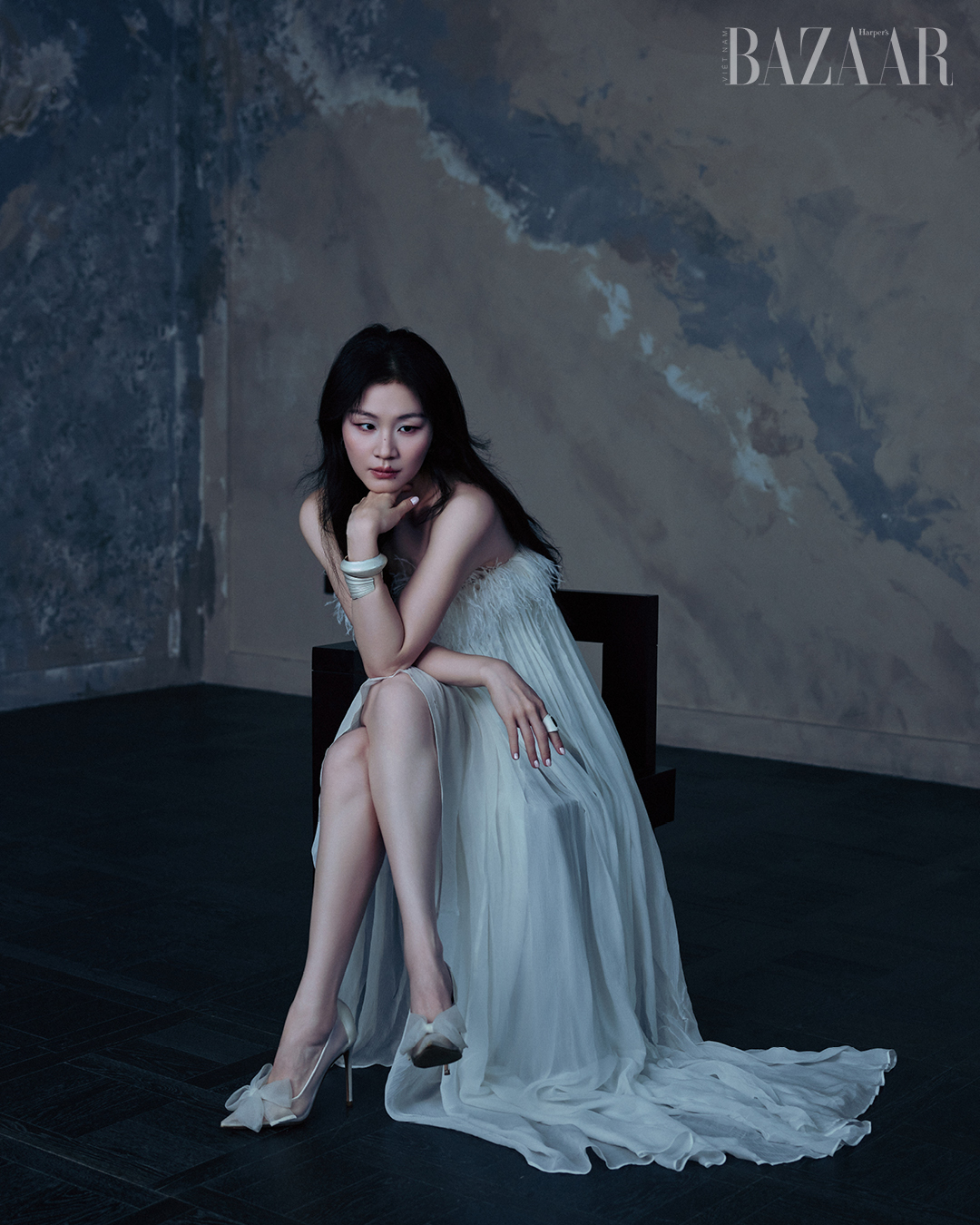
Dress: Awaylee. Shoes: Steve Madden. Bracelet and ring: Olio e Aceto.
Gradually, she has learned to distinguish between two things: plans and expectations.
A plan is a process you can control: scheduling rehearsals, maintaining your condition, and continually honing your craft, moving forward step by step. An expectation, by contrast, is an attachment to a result—a kind of invisible violence. You can plan to become a good actor and keep improving, but you cannot insist that you must win an award or achieve a particular outcome.
“There’s NOTHING WRONG with planning in itself, but EXPECTATIONS can easily BREED ANXIETY. If you REMOVE the expectation of a PARTICULAR OUTCOME, even when things do not TURN OUT as you hoped, you can STILL ENJOY THE PROCESS and find SATISFACTION in it. Expectations are NEVER EASY to fulfill COMPLETELY.”
Understanding the principle is one thing; putting it into practice is another. She, too, often gets caught up in expectations. Only when the pain has built to its peak does she belatedly realize that she has quietly developed an attachment and has been waiting for a desired result.
Earlier on, other people’s opinions often affected her. When someone praised her, doubts would rise in her mind: Do they mean it? Are they just being polite? Now, when she hears a compliment, she can calmly judge its intent and degree of sincerity. In this industry, much praise is simply a way to keep work moving smoothly, a courteous way of maintaining a pleasant atmosphere.
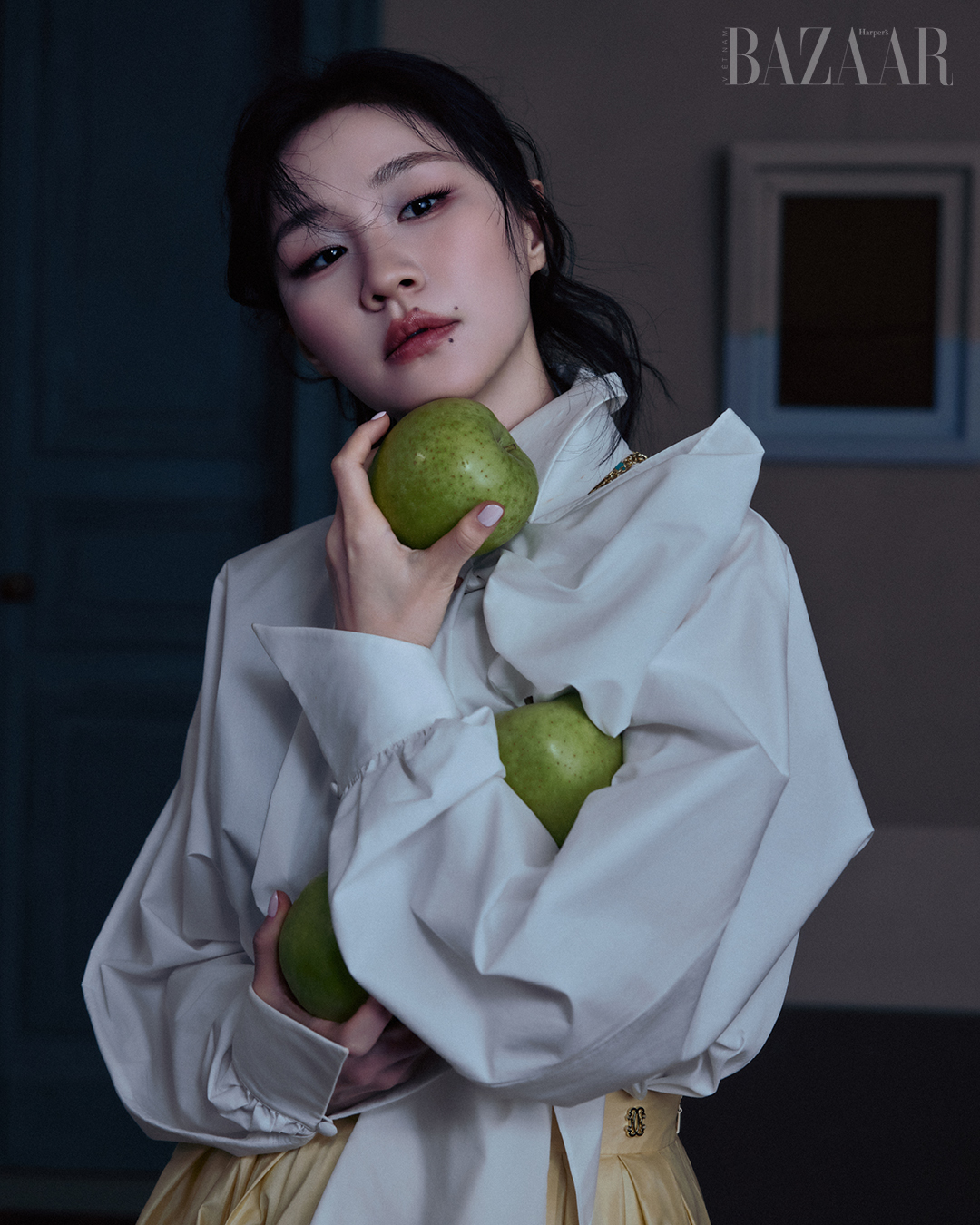
Shirt and skirt: Curiel. Shoes: Manolo Blahnik. Necklace: Tokokkino.
She no longer desperately chases every word of approval or feels compelled to determine whether every compliment is genuine. She hears it, responds politely, and understands what lies behind it, without tormenting herself over a single expression of recognition.
The hardest part is moving from “craving approval from others” to “no longer being wounded by other people’s judgments.” She shares an approach that took her a long time to work out: when a remark or situation seems to hurt you, and you alone, so intensely that you feel angry, wronged, or overwhelmed, do not rush to attack the other person. Instead, ask yourself: What do I need right now?
“Do I want to be ACCEPTED? To be SEEN? To be AFFIRMED? To feel that I MATTER?”
In East Asian societies, many people neglect their true needs for years. They grow accustomed to suppressing their emotions, until they cannot even identify the emptiness they feel inside. Often, the root of this inner turmoil is waiting for someone else to fill that void: waiting for a friend’s approval, a supervisor’s affirmation, or the tenderness they want from another person.
But other people can never fill that emptiness completely.
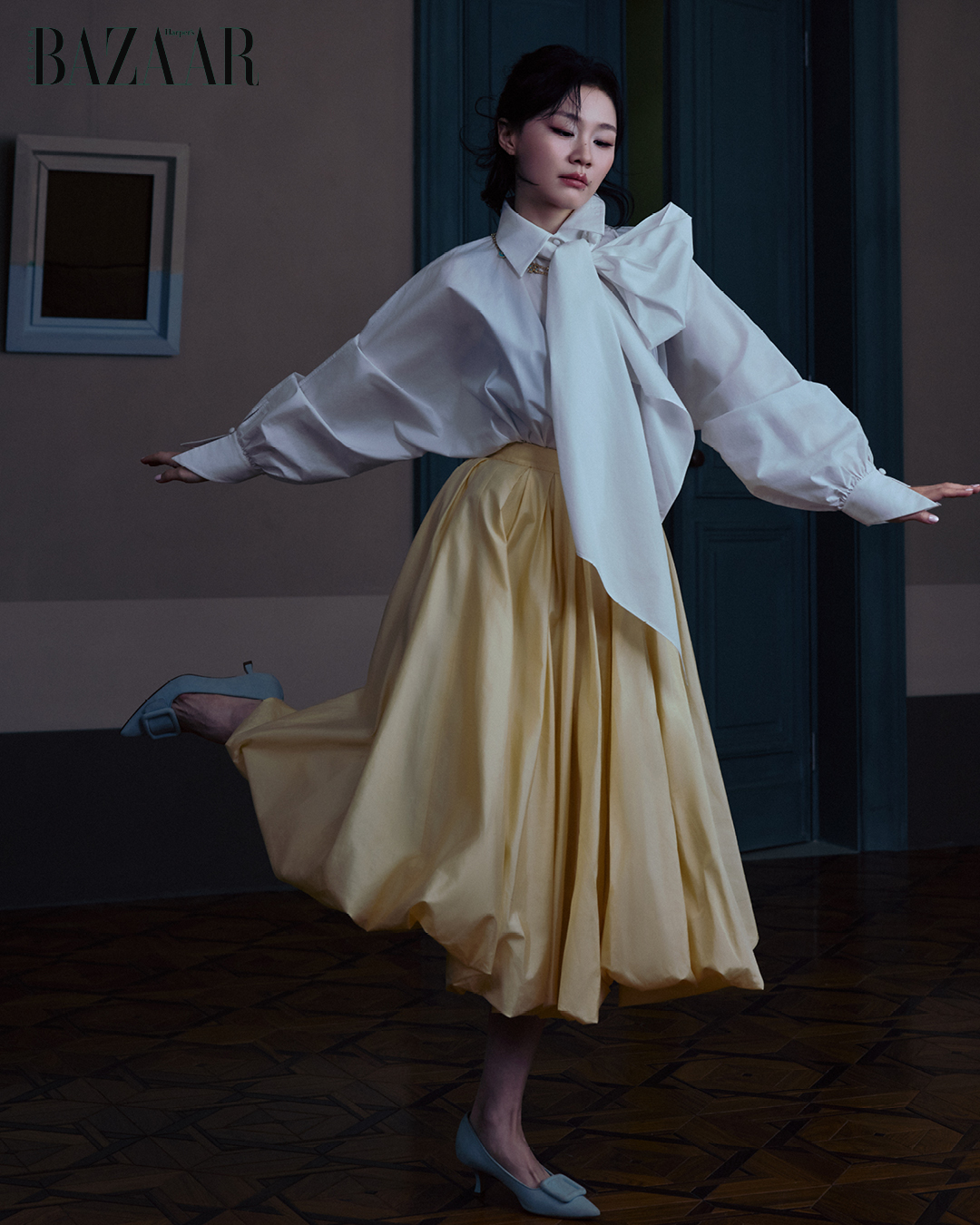
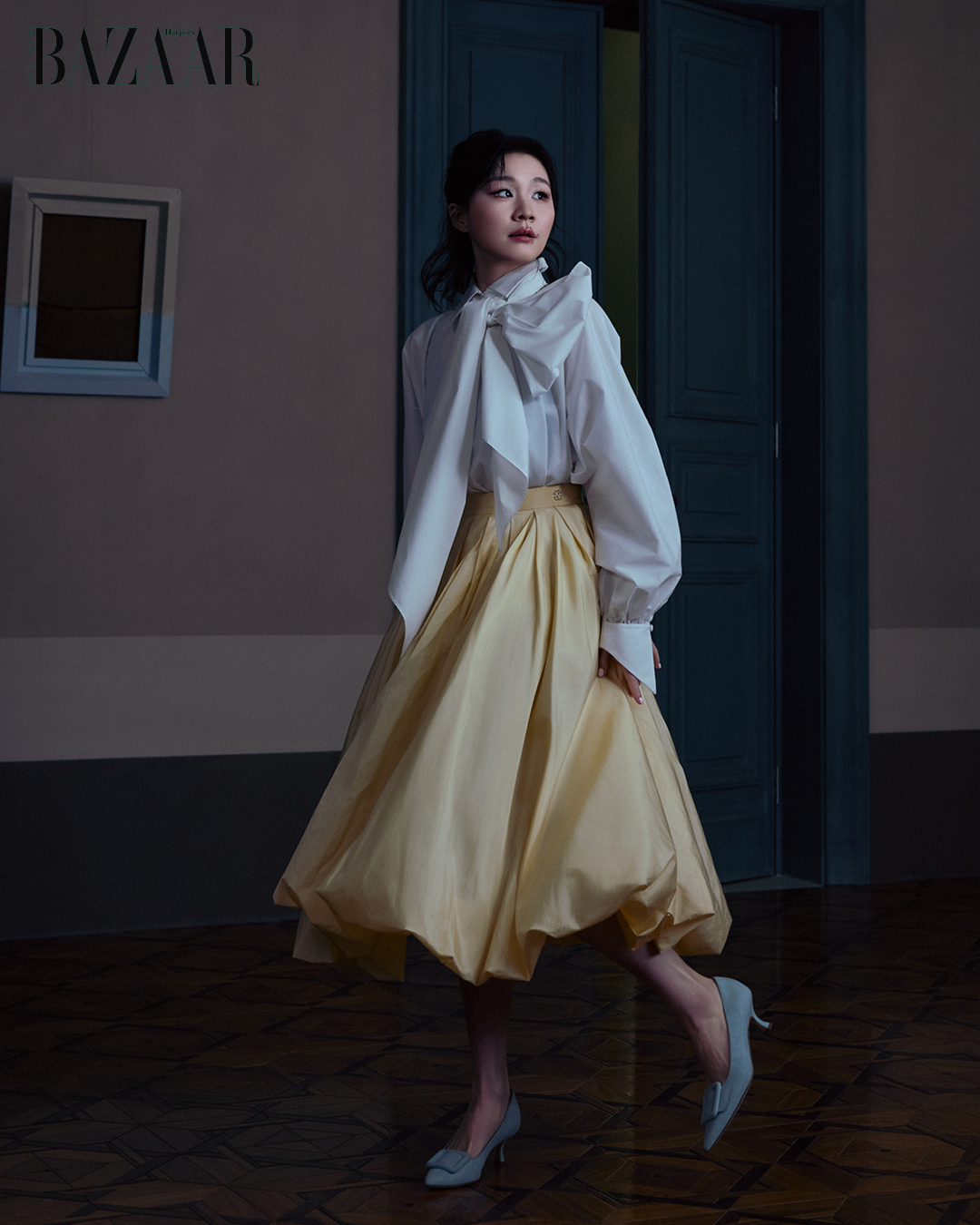
Shirt and skirt: Curiel. Shoes: Manolo Blahnik. Necklace: Tokokkino.
The real answer is to recognize the void and then learn to give yourself what you need. If you need a word of encouragement, say it to yourself: You’ve done well. When the source of affirmation shifts from others to yourself, outside judgments can no longer stir up great waves. The same hurtful words may still be thrown at you, but the lake within you will ripple only slightly.
It has been exactly ten years since Jin Jing appeared on Golden Night, and many people have marked the milestone for her, celebrating her tenth anniversary. Looking back at footage from those days, she sees her younger self declaring loudly that she would become a big star one day. Now, standing in the “one day” she spoke of then, Jin Jing has a curious feeling: time does not seem to have flowed in a straight line.
She does not feel she has been continually reinventing herself into an entirely new person. Much of what she thought about when she was younger and still at school shares the same core as what occupies her mind today; she has simply accumulated more experience. At certain moments, she slips back into a former state of mind; at others, she develops new insights.
“I can’t tell whether I’VE CHANGED or STAYED THE SAME. My past self, present self, and future self seem to COEXIST in a SINGLE MOMENT, rather than forming A STRAIGHT LINE moving forward.”
The spotlights come and go, and one role follows another. She no longer rushes to seek answers from the outside world, nor does she measure herself against other people’s standards. Acting is what she continues to pursue; her inner work is to understand herself gradually and keep the lake within her calm.
There is no need to race against time or force an outcome. Leaving each choice in her own hands is the best place for her to be right now.
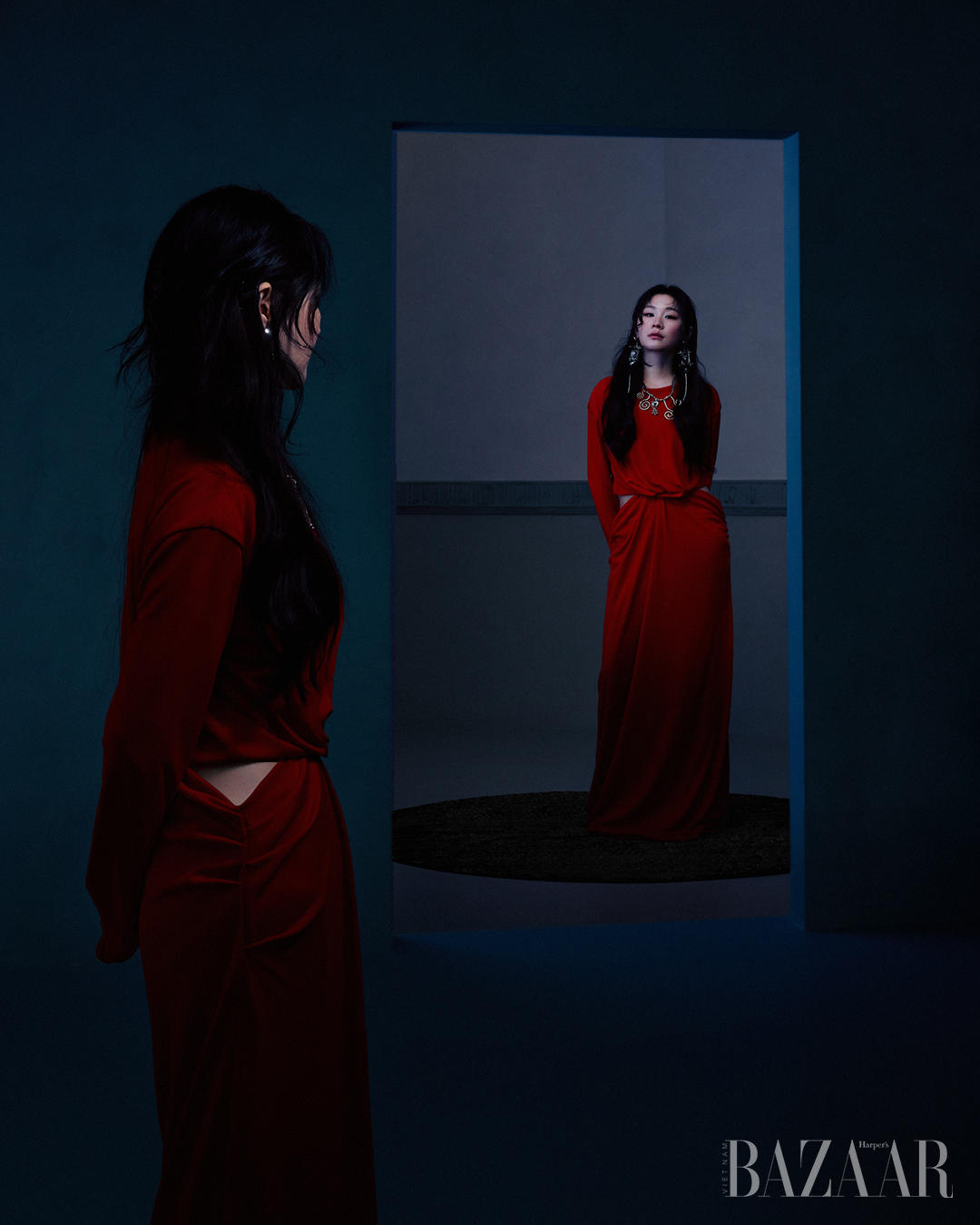
Dress: Shangyi by Shang1.
Producer: Nan Zhang.
Photographer: @sanshui1993.
Creative & Styling: @_stormwhisper
Makeup: Cici
Hair: @刘雪成MQ
Artist Coordination: Sian
Text & Video Coordination: @estheryunki
Writer: Zen.
Video: Haw
Styling Assistant: 晴子, Oui
Location: Inlabism 研何 SPACE
Harper’s Bazaar Vietnam